The Challenge: Fragmented Customer Data
Your customers interact with you across many channels: your website, your app, your sales team. Each interaction generates a different identifier: a Stripe ID, an anonymous visitor ID, a user profile ID. This creates a scattered, incomplete picture of your customer. It’s impossible to see their full journey, which makes it hard to answer critical business questions:- How many unique customers do we really have?
- Which marketing channels bring in our most valuable customers?
- What’s the true ROI of our sales activities?
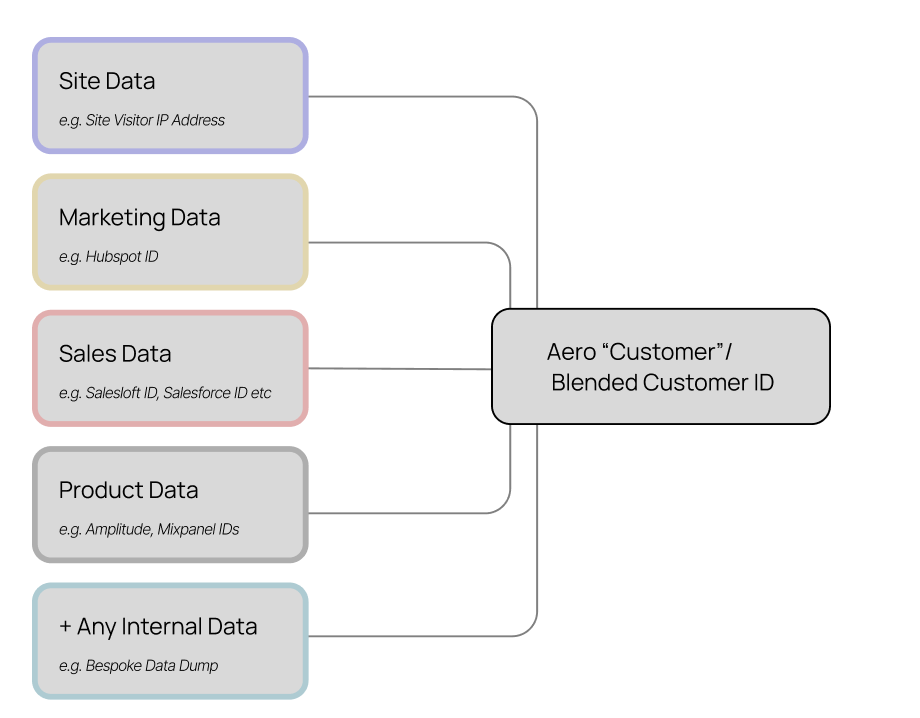
- Unified view of a single user across multiple systems.*
The Aero ID Graph: Your Single Source of Truth
We create this unified ID using a sophisticated ID Stitching process. It intelligently links all the disparate identifiers that belong to the same person, giving you a single, comprehensive view of their journey. The result is a clean, unified graph of your customers. With the Aero Customer ID, you can analyze behavior across your entire business.SQL Guide: Joining with the ID Graph
SQL Guide: Joining with the ID Graph
The key to using the ID Graph is the 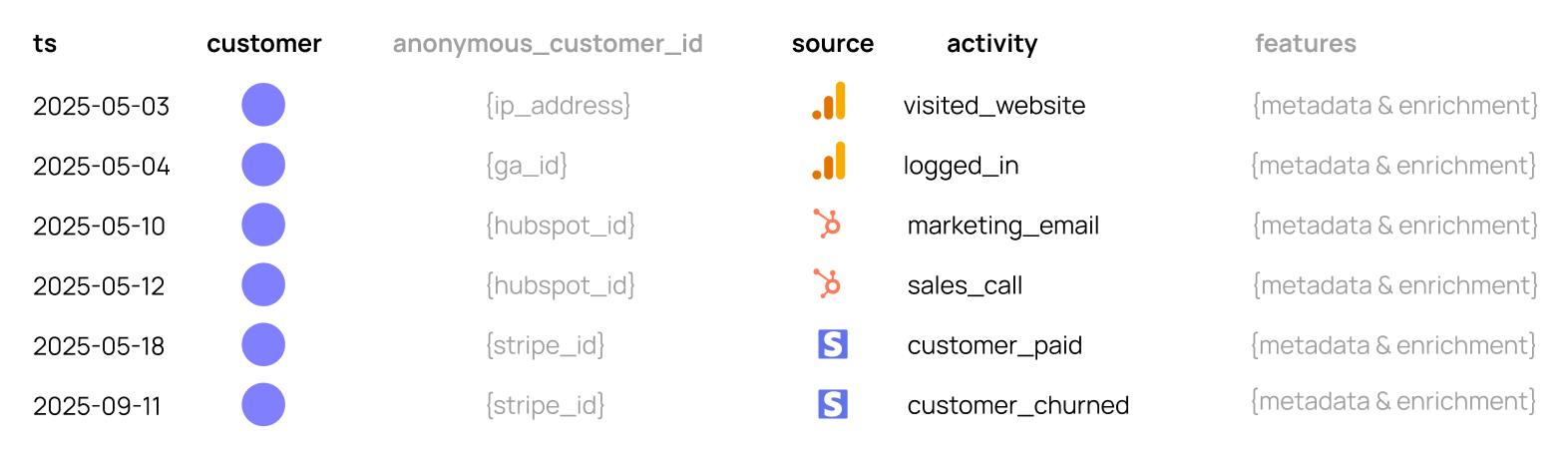
AERO_DB.ANALYTICS.OVERRIDDEN_ID_GRAPH table. This table maps every source ID (we call this a node) to its unified AERO_USER_ID.AERO_USER_ID.Here’s how to enrich your data with the Aero Customer ID. If you have a table your_table with a user identifier your_user_id, you can run this query:Example: Accurately Measuring Your Funnel
Example: Accurately Measuring Your Funnel
Let’s say you want to calculate your sales win rate: how many demos lead to a closed deal?A common mistake is to count a source-specific ID, like a Corrected Query:
customer_id from one of your systems. This will over-count your users, because one account can have multiple customer_id values.The correct approach is to always count distinct AERO_USER_IDs from the ID graph - e.g. how many true, deduped users have demoedIncorrect Query:From Data to Decisions: Answering Your Biggest Questions
By connecting every customer touchpoint, the ID Graph helps you move beyond simple metrics and answer the complex questions that drive growth.- Sales Effectiveness: What are my salespeople really spending their time on? Are their activities leading to revenue?
- Churn Analysis: Which users are at risk of churning, and what patterns or touchpoints predict customer loss?
- Channel ROI: Which marketing channels don’t just bring in leads, but drive the most wins and highest lifetime value?
- Full-Funnel Attribution: Can we draw a straight line from a specific marketing campaign to the revenue generated by an SDR?
Key Takeaways
- The Aero ID Graph unifies fragmented customer data into a single customer view.
- Use the
AERO_USER_IDfor all your user-level analysis to ensure accuracy. - An accurate ID graph is the foundation for answering your most important business questions about sales, marketing, and product.